Why Your Automated Gold Prices Should Never End in a Random Decimal
Multiply current gold rate by weight, add making charges and wastage, and the result is almost never a clean number. Left as-is, every price on the storefront ends in an odd decimal, which quietly signals to shoppers that nothing was reviewed by a person — even when the underlying calculation is perfectly sound.
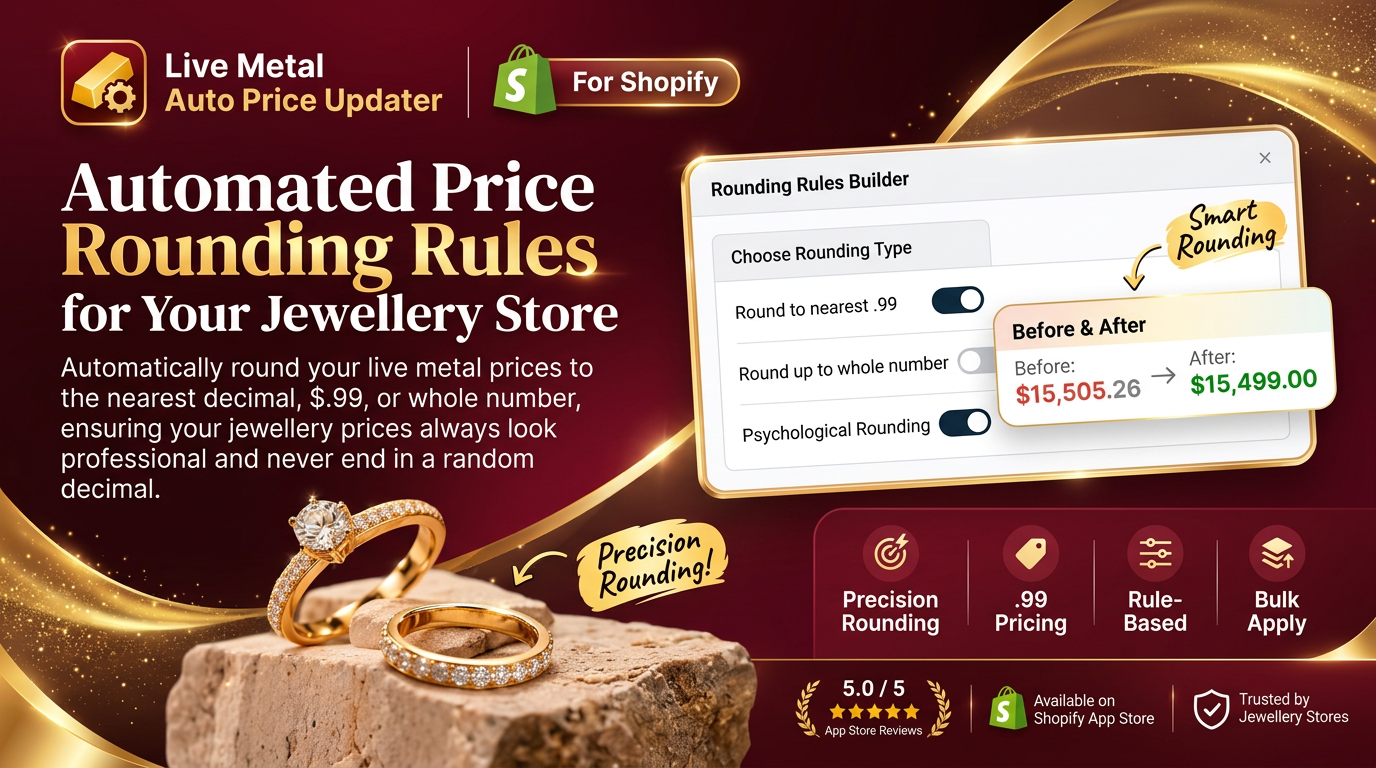
Round up to the nearest whole number, round to the nearest 9 or 99 ending, or round to the nearest 5 or 10 — set per metal type or per collection, same as the pricing formulas themselves. A $412.37 pendant becomes $412.99 or $415, whichever matches how the rest of the catalog is priced.
Always rounding up (never down) on live metal-rate pricing means the rounding itself never erodes margin on volatile days — it only ever adds a few cents of buffer. Over thousands of SKUs updated daily, that buffer matters more than it looks like it would on one product.
7-day free trial, no credit card required.
Install App Free →
More at klyx.agency/live-metal-auto-price-updater.