Gold Price Volatility: How Jewelry Store Owners Can Protect Their Margins
Gold is not a stable commodity. In 2024 alone, the price of gold moved from roughly $2,000/oz to over $2,700/oz — a 35% swing over the year. Month to month, swings of 3–8% are common. Week to week, 1–3% moves happen regularly.
Silver is even more volatile. It's not unusual for silver to move 10% in a single week during market stress.
For a jewelry store, here's what that means in practice: a 10g gold ring priced with 18K gold at ₹5,500/g has a metal cost of roughly ₹41,250. If gold moves up 5%, that same ring now has a ₹43,300 metal cost — but your store still shows the old price. Every sale at the old price is a margin loss.
Mistake 1: Pricing on a fixed markup, not a live formula
Setting a static price and updating it weekly (or monthly) means you're always behind. Markets don't wait for your update schedule.
Mistake 2: No floor protection
If you automate pricing without setting a minimum price floor, a sharp metal price drop can push your prices below your cost of goods sold. Automation without guardrails is dangerous.
Mistake 3: Overreacting to daily spikes
Updating prices every time gold ticks up or down by 0.5% creates customer confusion and erodes trust. Customers who check your site twice in a day and see different prices get spooked.
Here's the framework that protects margins without causing customer confusion:
1. Formula-based pricing
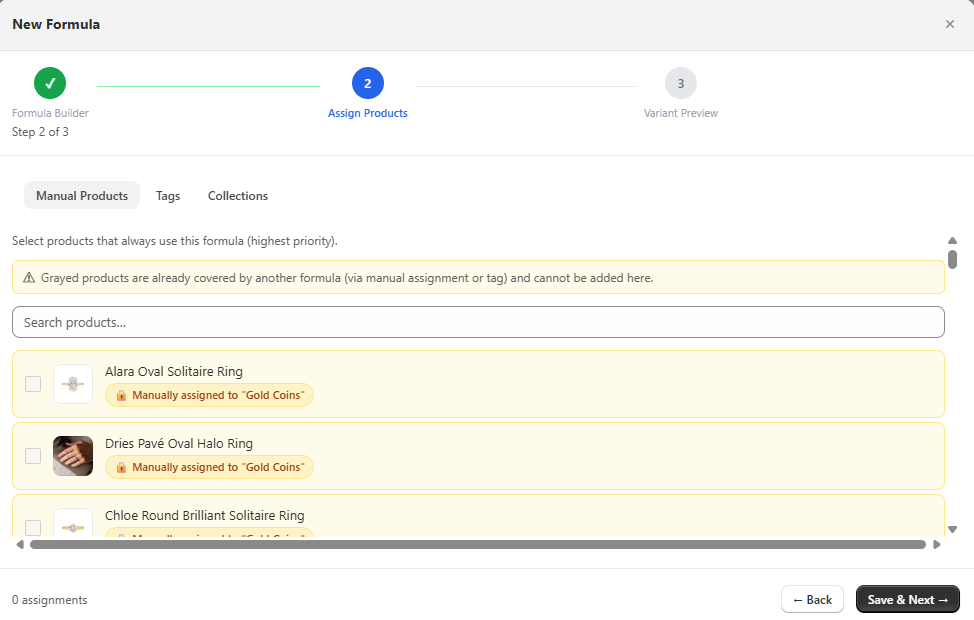
Express every product's price as a formula: (metalWeight × spotPrice × purity) × (1 + makingCharge%). When spot moves, prices recalculate automatically — no manual work.
2. Stop-loss floor per metal
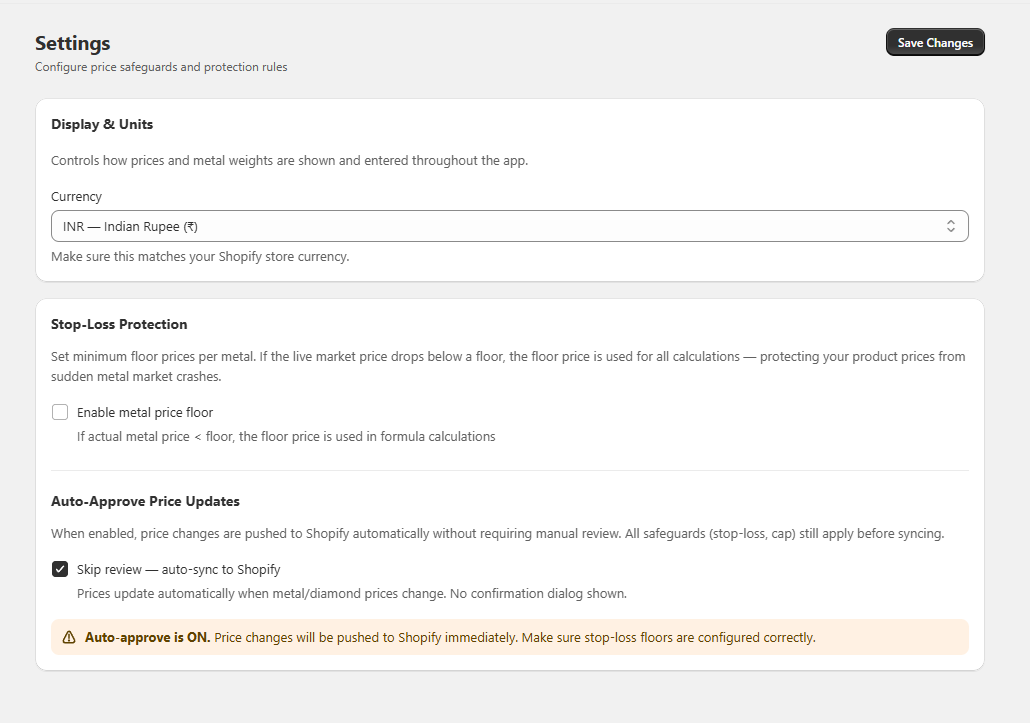
Set a minimum viable price per gram for each metal. If the formula calculates below your floor, the floor wins. This ensures you never sell at a loss, even if gold crashes 20% overnight.
3. Volatility smoothing
Use a 7-day moving average of spot prices instead of live-tick prices. This smooths out single-day spikes and gives your customers consistent, trustworthy pricing — while still tracking the trend.
4. Daily sync, not real-time
Update prices once per day (usually at a consistent time — e.g., 6am before store traffic peaks). This keeps you current without creating an intraday moving-target problem.
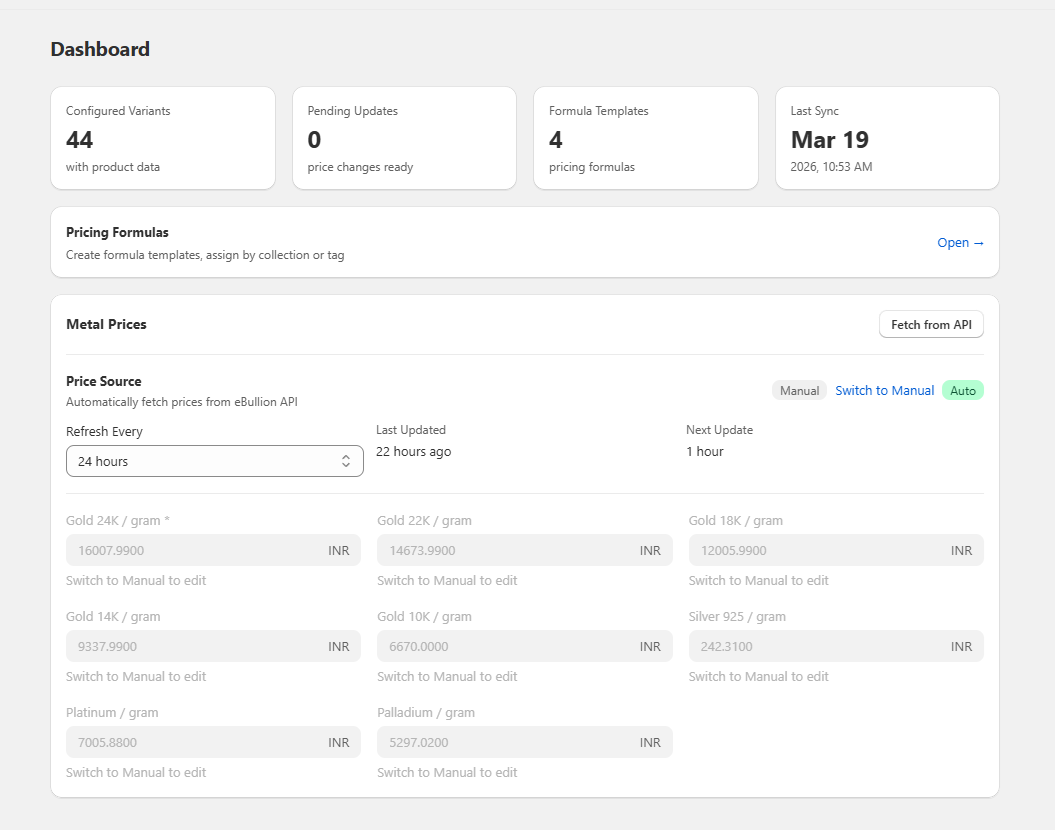
All four of the above strategies are built into Live Metal Bulk Price Updater for Shopify:
• The Formula Builder lets you define the exact pricing expression per product group
• Stop-Loss Floors are configurable per metal in Settings
• Volatility Smoothing (7-day moving average) is a toggle in Settings
• Auto-Approve runs the full sync daily without manual intervention
• Preview mode shows you the full before/after diff before committing any changes
A store with 200 products, averaging 5 variants each = 1,000 variants. If gold moves 3% and the store reprices manually once a week:
• Average order value: ₹15,000
• Metal cost as % of price: ~60% (₹9,000 metal cost per order)
• 3% gold move = ₹270 margin erosion per order if not repriced
• 50 orders/week at ₹270 loss each = ₹13,500 lost per week from a single gold move
Automated daily repricing closes that gap entirely. At $9.99/month, the math is obvious.
Live Metal Bulk Price Updater is free for 7 days. No credit card required.
Install Free on Shopify →
Read the FAQ or check the full app overview.