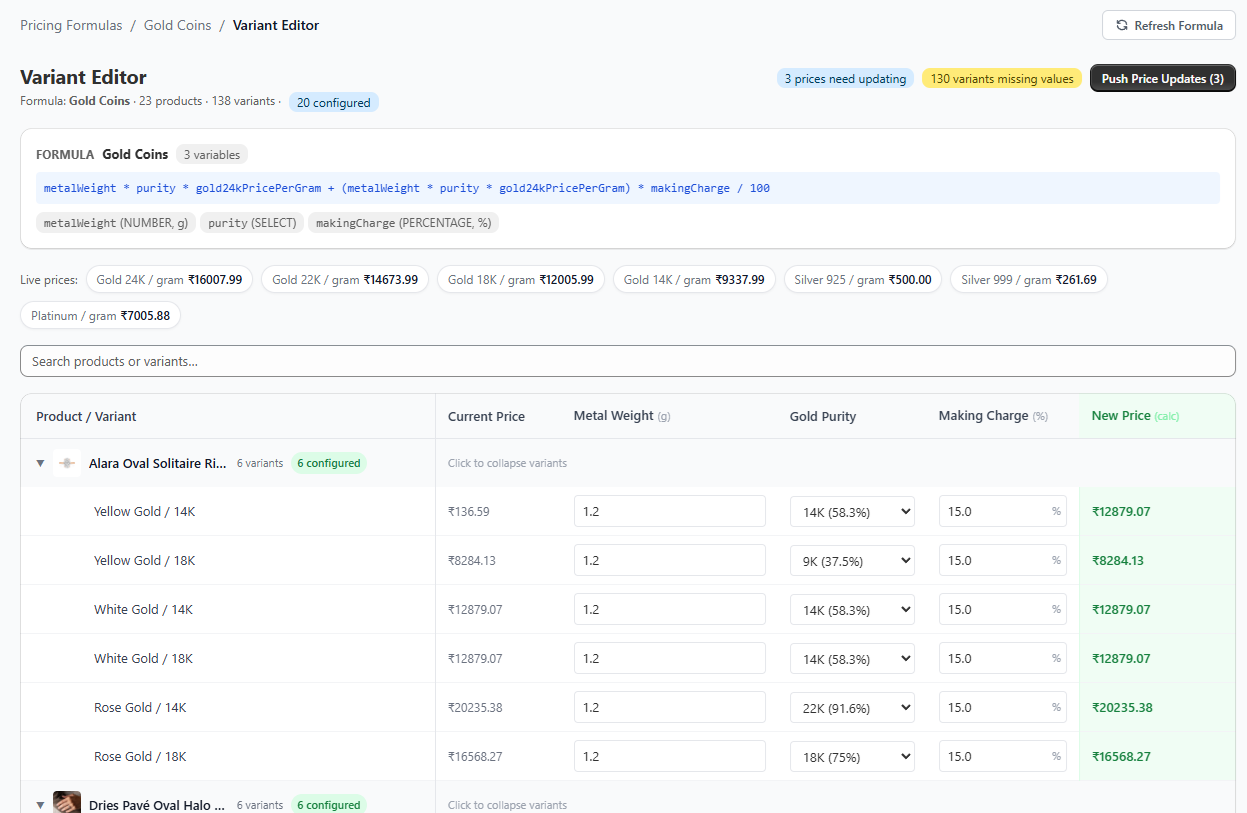
Manual vs Automated Jewelry Pricing on Shopify: The True Cost Comparison
For most Shopify jewelry stores not using automation, the weekly pricing workflow looks something like this:
1. Check the morning gold/silver spot price
2. Open a spreadsheet with your products, weights, and purities
3. Recalculate prices for each variant manually or with spreadsheet formulas
4. Log into Shopify admin
5. Navigate to each product, open each variant, type in the new price, save
6. Repeat for every product in your catalog
7. Hope you didn't make a typo
For a store with 100 products and 4 variants each, that's 400 individual price edits. At 30 seconds per variant, that's 3.3 hours — every single time you reprice.
Cost 1: Your time (or your team's time)
If you reprice weekly and it takes 3 hours, that's 12 hours a month. At even a modest ₹500/hr opportunity cost, that's ₹6,000/month in time — just on price updates. Scale the catalog and frequency and it compounds fast.
Cost 2: Margin lag
Gold doesn't wait for your weekly reprice. If gold rises 4% on Monday and you reprice on Friday, every order placed Tuesday through Thursday was sold at a 4% margin deficit. On a ₹20,000 order with 60% metal content, that's ₹480 per order — gone.
Cost 3: Human error
Manual data entry means typos. A misplaced decimal on a 10g gold ring — ₹45,000 priced as ₹4,500 — and you're selling at a 90% loss. One error can wipe out weeks of profit. Spreadsheet-to-Shopify copy-paste is the highest-risk step in the whole workflow.
Here's how the two approaches compare across what actually matters:
| Factor | Manual Repricing | Live Metal Bulk Price Updater |
|---|---|---|
| Time per reprice cycle | 2–5 hours (400 variants) | ~30 seconds |
| Pricing frequency | Weekly or less | Daily (automated) |
| Margin lag risk | High — days behind market | Near-zero — updated daily |
| Human error risk | High — typos, copy-paste errors | None — formula-driven |
| Floor price protection | Manual vigilance only | Automatic stop-loss per metal |
| Multi-currency support | Requires separate calculation | Auto via live exchange rates |
| Scalability | Effort grows with catalog size | Same effort for 100 or 10,000 variants |
| Monthly cost | Staff time + error risk | $9.99/month |
To be fair: manual pricing works fine if:
• You have fewer than 20–30 variants total
• You sell fixed-price or costume jewelry where metal spot rate isn't a factor
• You reprice less than once a month and margins are thick enough to absorb lag
If any of those aren't true — if you sell fine jewelry, you have a growing catalog, or you're watching margins — manual pricing is actively working against you.
The common objection to automation is "setup is complex." With Live Metal Bulk Price Updater, the full setup is:
1. Install the app (2 min)
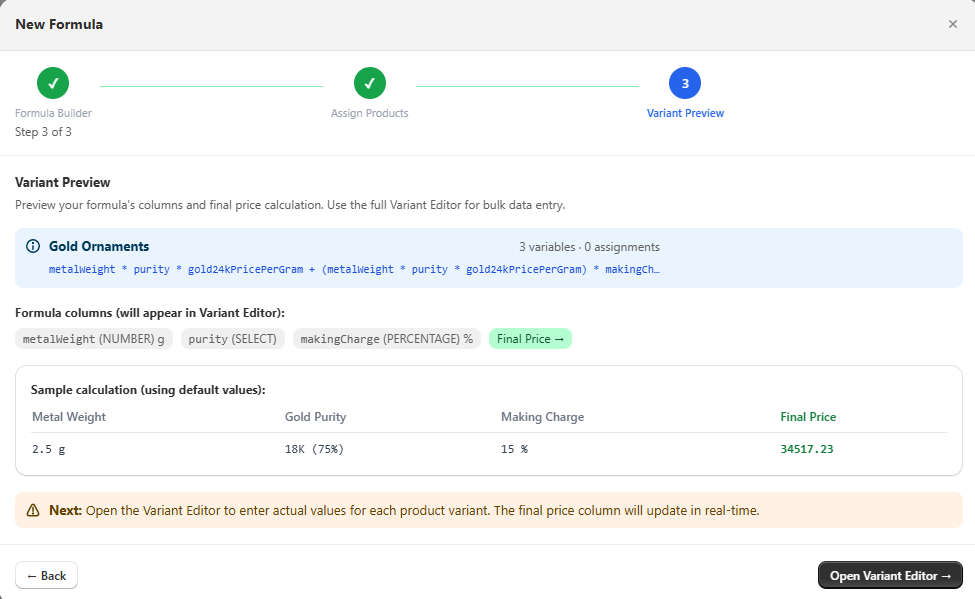
2. Build your pricing formula in the Formula Builder (10 min)
3. Enter metal weight + purity per variant in the Variant Editor (30–60 min for most catalogs)
4. Preview prices, push, enable Auto-Approve
After that one-time setup, you never manually reprice again.
No credit card required. Works on all Shopify plans.
Install Free on Shopify →
Questions? Read the FAQ or contact us.